Course Introduction
Skin Suturing – Basic Skin Wound Closure is a competency-focused, simulation-based clinical skills course designed for undergraduate MBBS students. The course introduces learners to the fundamental principles and practical techniques required for safe and effective skin wound closure.
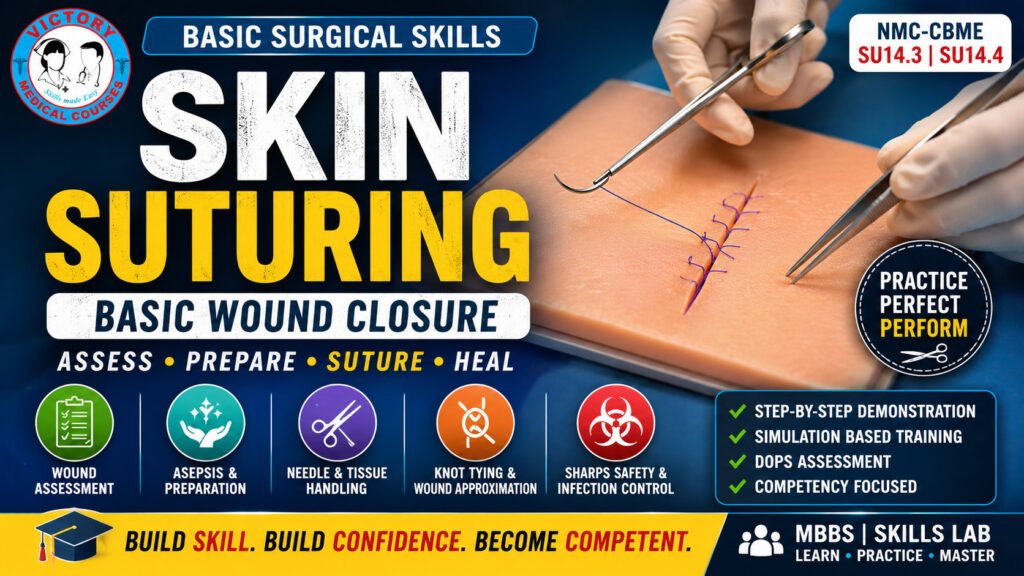
Aligned with the NMC Competency-Based Medical Education (CBME) curriculum, the course addresses SU14.3 – materials and methods used for surgical wound closure and SU14.4 – demonstration of asepsis and suturing in a simulated environment.
The course uses a structured DOAP approach – Demonstrate, Observe, Assess and Perform – allowing students to progress from understanding the principles of suturing to supervised hands-on practice and direct assessment.
Course Learning Outcomes
By the end of this course, the learner will be able to:
Knowledge
- Explain the principles of wound healing and wound closure.
- Describe the indications and basic principles of skin suturing.
- Identify commonly used suture materials and needles.
- Differentiate absorbable and non-absorbable sutures.
- Identify and describe the function of basic suturing instruments.
- Explain the principles of wound-edge approximation and eversion.
- Describe common complications of skin suturing.
Practical Skills
The learner will be able to:
- Perform appropriate hand hygiene and prepare the working area.
- Demonstrate appropriate aseptic technique.
- Prepare and organise suturing equipment.
- Handle a needle holder, forceps and scissors correctly.
- Load and control a suture needle safely.
- Handle simulated tissue gently.
- Perform a simple interrupted skin suture.
- Take appropriately positioned and reasonably symmetrical bites.
- Approximate wound edges with appropriate tension.
- Achieve appropriate wound-edge eversion.
- Tie a secure knot.
- Trim suture ends appropriately.
- Inspect the completed wound closure.
- Demonstrate safe sharps disposal.
Professionalism
The learner will also demonstrate:
- Appropriate procedural communication.
- Respect for patient safety and dignity.
- Attention to infection prevention.
- Safe handling of sharps.
- Recognition of personal limitations.
- Willingness to seek appropriate supervision.
Course Structure
The course is organised into progressive learning modules:
Module 1 – Introduction to Skin Suturing
Introduction to the importance of basic wound closure, learning objectives and expected competency.
Module 2 – Wound Assessment
Learners explore systematic wound assessment, including wound location, length, depth, contamination, foreign bodies, tissue viability and possible deeper structural injury.
Module 3 – Sutures, Needles and Instruments
Identification and appropriate use of common suturing instruments, needle types and suture materials, including absorbable and non-absorbable sutures.
Module 4 – Aseptic Technique and Safety
Hand hygiene, PPE, preparation of the working field, maintenance of asepsis, infection prevention and safe sharps handling.
Module 5 – Needle and Instrument Handling
Practical training in needle-holder control, forceps handling, needle orientation and gentle tissue manipulation.
Module 6 – Simple Interrupted Suturing
Step-by-step demonstration of the fundamental simple interrupted skin suture, including needle entry, tissue bites, wound-edge approximation, eversion and tension control.
Module 7 – Knot Tying
Demonstration and practice of secure knot tying, appropriate tension and correct trimming of suture ends.
Module 8 – Common Errors and Troubleshooting
Recognition and correction of common errors such as unequal bites, excessive tension, wound-edge inversion, poor knot security and inappropriate tissue handling.
Module 9 – Simulation Practice
Students perform repeated supervised attempts using a synthetic skin/task trainer, receiving immediate faculty feedback and opportunities for deliberate practice.
Module 10 – Competency Assessment
Learners demonstrate the complete procedure using a structured DOPS/direct-observation checklist, followed by feedback, remediation and reassessment where required.