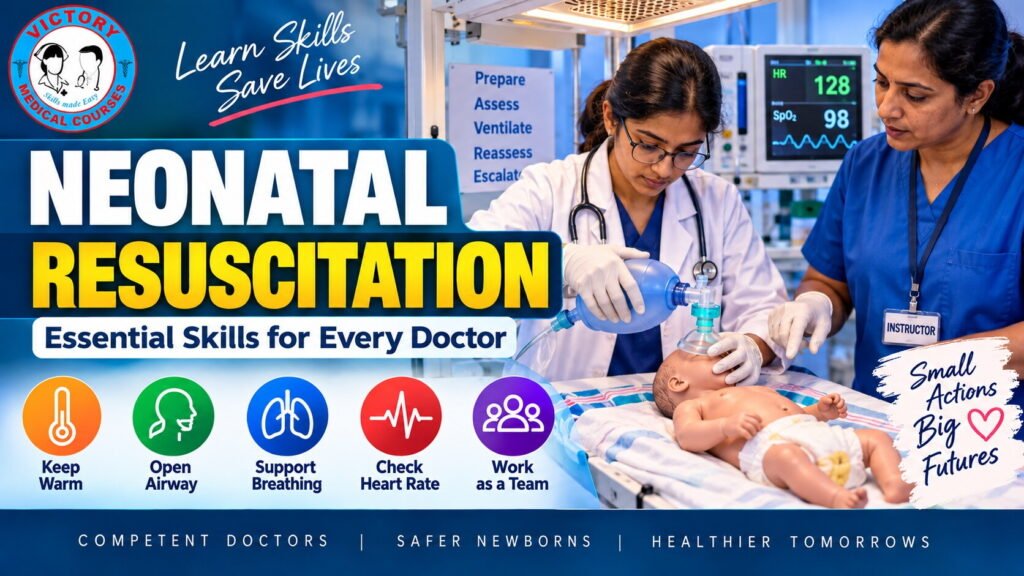
Neonatal resuscitation is an essential clinical skill for every medical graduate. The first few minutes after birth can be critical, and healthcare professionals must be able to recognize a newborn who requires assistance, initiate appropriate basic interventions, provide effective ventilation when indicated, reassess the newborn and work efficiently as part of a resuscitation team.
This course provides hands-on, simulation-based training in neonatal resuscitation for undergraduate MBBS students. The program is designed around practical skills acquisition rather than theoretical learning alone.
Students learn through a combination of faculty demonstration, interactive discussion, guided hands-on practice, realistic neonatal simulation scenarios, team-based exercises, structured debriefing and competency-based assessment.
The course provides students with an opportunity to practise neonatal resuscitation in a safe environment before applying these principles in the clinical setting.
LEARNING OUTCOMES
At the completion of this course, the learner should be able to:
Knowledge
- Explain the principles and objectives of neonatal resuscitation.
- Describe the initial assessment of a newborn immediately after birth.
- Identify clinical findings suggesting that a newborn requires resuscitative support.
- Explain the importance of maintaining newborn temperature.
- Describe appropriate neonatal airway positioning.
- Explain the principles of positive-pressure ventilation.
- Recognize indicators of effective and ineffective ventilation.
- Describe a systematic approach to ventilation troubleshooting.
- Explain the importance of repeated reassessment.
- Describe the principles of effective communication and teamwork during neonatal emergencies.
Practical Skills
The learner should be able to:
- Prepare a neonatal resuscitation area.
- Check essential equipment before use.
- Perform an initial assessment of a newborn.
- Maintain warmth and dry the newborn appropriately.
- Position the neonatal airway correctly.
- Provide appropriate tactile stimulation when indicated.
- Select an appropriate neonatal mask.
- Demonstrate correct mask positioning and seal.
- Perform bag-mask ventilation on a neonatal mannequin.
- Assess chest movement during ventilation.
- Identify ineffective ventilation.
- Troubleshoot common ventilation problems.
- Reassess breathing and heart rate.
- Communicate effectively with the resuscitation team.
- Recognize when additional assistance or escalation is required.
Professional Skills
The learner should demonstrate:
- Patient safety awareness
- Calm and systematic behaviour
- Effective communication
- Teamwork
- Appropriate leadership and followership
- Recognition of personal limitations
- Timely request for assistance
- Professional behaviour during emergencies
COURSE STRUCTURE
The course is delivered as a simulation-based procedural learning experience.
MODULE 1 — INTRODUCTION TO NEONATAL RESUSCITATION
Students are introduced to:
- Importance of neonatal resuscitation
- Principles of newborn transition after birth
- Recognition of newborns requiring assistance
- Importance of preparation
- Team readiness
- Patient safety
MODULE 2 — PREPARATION OF THE RESUSCITATION AREA
Students learn how to prepare the environment and equipment before resuscitation.
Topics include:
- Resuscitation area preparation
- Neonatal warmer
- Towels and warming materials
- Bag-mask ventilation equipment
- Neonatal masks
- Suction equipment
- Oxygen/monitoring equipment where applicable
- Equipment checks
- Team preparation
Skill focus: Being prepared before an emergency occurs.
MODULE 3 — INITIAL ASSESSMENT OF THE NEWBORN
Students practise rapid assessment of:
- Breathing
- Tone
- Heart rate
- Overall clinical condition
- Need for routine care versus resuscitative intervention
The emphasis is on rapid recognition and appropriate decision-making.
MODULE 4 — INITIAL STEPS
Students practise:
- Maintaining warmth
- Drying
- Removing wet linen
- Appropriate positioning
- Airway assessment
- Tactile stimulation when indicated
The instructor emphasizes that basic supportive measures should be performed efficiently and should not unnecessarily delay indicated ventilation.
MODULE 5 — NEONATAL AIRWAY POSITIONING
Students practise correct positioning of the newborn’s head and airway.
They learn to recognize:
- Excessive flexion
- Excessive extension
- Poor airway positioning
- Correct neutral/slightly extended positioning
The skill is practised repeatedly using the neonatal mannequin.
MODULE 6 — POSITIVE-PRESSURE VENTILATION
This is the major practical component of the course.
Students learn:
- Selection of the appropriate mask
- Correct mask placement
- Achieving an effective seal
- Maintaining airway position
- Bag-mask ventilation technique
- Observing chest movement
- Assessing effectiveness of ventilation
- Reassessment following intervention
Students repeatedly practise the procedure until they can demonstrate the technique safely and systematically.
Important: Exact ventilation parameters and advanced resuscitation interventions should be taught according to the current institutional neonatal resuscitation protocol and currently adopted guideline.
MODULE 7 — RECOGNIZING EFFECTIVE VENTILATION
Students learn that simply squeezing the ventilation device does not guarantee effective ventilation.
They are taught to look for evidence that ventilation is working.
Key observations include:
- Appropriate chest movement
- Clinical response
- Heart-rate response where applicable
- Overall improvement
The simulation mannequin is used to demonstrate both effective and ineffective ventilation.
MODULE 8 — VENTILATION TROUBLESHOOTING
Students practise responding to a deliberately created ventilation problem.
Possible simulated problems include:
- Poor mask seal
- Incorrect head position
- Incorrect mask placement
- Airway obstruction
- Ineffective ventilation technique
Students are taught to use a systematic troubleshooting approach rather than repeatedly ventilating without correcting the underlying problem.
MODULE 9 — REASSESSMENT
Students learn that neonatal resuscitation is a dynamic process.
The sequence is reinforced:
Intervene → Assess Response → Correct Problems → Reassess → Escalate When Required
Students practise reassessing:
- Breathing
- Heart rate
- Clinical response
- Effectiveness of ventilation/intervention
MODULE 10 — TEAM-BASED NEONATAL RESUSCITATION
Students participate in realistic team-based simulation scenarios.
Roles may include:
- Team leader
- Airway/ventilation provider
- Equipment assistant
- Monitoring/documentation assistant
Students practise:
- Role allocation
- Clear communication
- Closed-loop communication
- Calling for assistance
- eporting clinical findings
- Coordinating interventions
- Escalation