
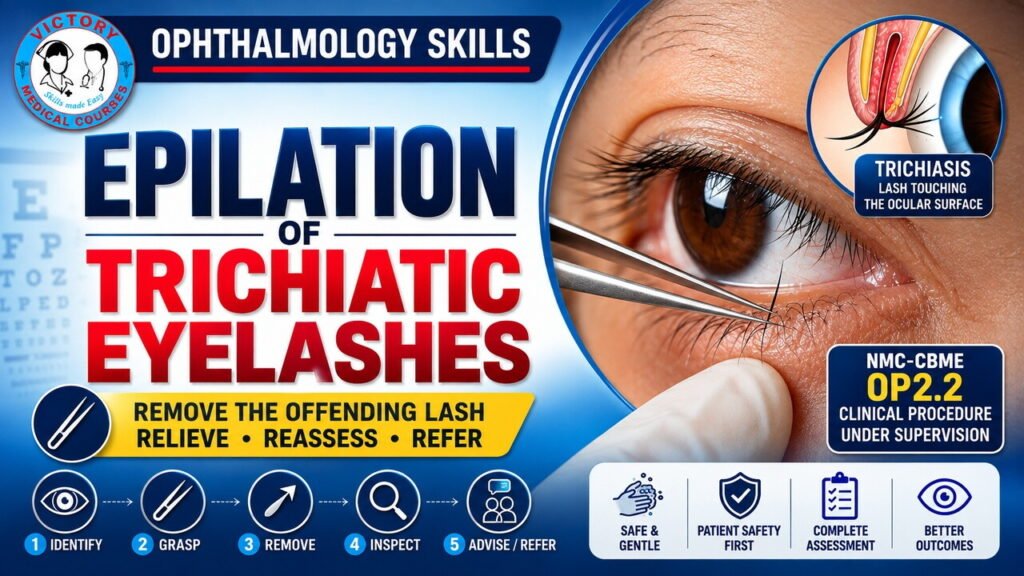
EPILATION OF TRICHIATIC EYELASHES
This competency-based Ophthalmology skills course provides undergraduate medical students with a structured, practical approach to the recognition and safe epilation of trichiatic eyelashes. The course is designed around the NMC-CBME competency OP2.2 and uses a DOAP (Demonstrate–Observe–Assist–Perform) methodology to develop procedural knowledge, psychomotor skills, clinical reasoning, patient communication, and professional behaviour.
Trichiasis is characterized by abnormal inward direction of eyelashes toward the ocular surface. Although epilation is a relatively simple procedure, safe performance requires correct identification of the offending lash, appropriate patient preparation, precise instrument handling, controlled traction, protection of the cornea, and post-procedure reassessment.
LEARNING OUTCOMES
By the end of the course, the student should be able to:
Knowledge
- Define trichiasis.
- Explain the clinical significance of trichiasis.
- Differentiate trichiasis from entropion.
- Identify indications for epilation.
- Describe the instruments and equipment required.
- Explain the correct sequence of the procedure.
- Identify potential complications.
- Recognize situations requiring further ophthalmic assessment.
Clinical and Procedural Skills
The learner should be able to:
- Perform appropriate hand hygiene and standard precautions.
- Introduce themselves and communicate appropriately with the patient.
- Explain the procedure and obtain appropriate consent.
- Position the patient safely and provide adequate illumination.
- Identify the offending trichiatic eyelash.
- Assess the eyelid margin and ocular surface.
- Select and handle fine epilation forceps correctly.
- Stabilize the eyelid gently.
- Grasp the offending eyelash close to its base.
- Remove the eyelash using controlled traction.
- Avoid unnecessary contact with the cornea.
- Inspect the eyelid margin and ocular surface following removal.
- Provide appropriate post-procedure advice.
- Recognize recurrent or complicated trichiasis requiring referral.
- Document the procedure appropriately.
Professional Skills
The student should demonstrate:
- Respectful patient communication.
- Appropriate consent practices.
- Attention to patient comfort and dignity.
- Infection-prevention practices.
- Safe handling of ophthalmic instruments.
- Recognition of personal limitations.
- Appropriate use of faculty supervision.
COURSE STRUCTURE
The course follows a progressive competency-based learning pathway.
MODULE 1 — Understanding Trichiasis
Students learn:
- Definition of trichiasis.
- Normal versus abnormal eyelash direction.
- Symptoms and clinical significance.
- Effects of lashes rubbing against the ocular surface.
- Basic clinical assessment.
MODULE 2 — Trichiasis versus Entropion
Students learn to distinguish:
- Isolated trichiasis.
- Entropion.
- Eyelid scarring and other associated abnormalities.
The key clinical principle is reinforced:
Epilation removes the offending lash; it does not correct eyelid malposition.
MODULE 3 — Equipment and Patient Preparation
Students become familiar with:
- Fine ophthalmic epilation forceps.
- Adequate illumination.
- Cotton-tipped applicators and gauze.
- Gloves where indicated.
- Hand-hygiene requirements.
- Waste disposal.
Patient communication, positioning, consent and procedural preparation are also addressed.
MODULE 4 — Identifying the Offending Lash
Students practise:
- Examining the eyelid margin.
- Identifying the abnormal lash.
- Determining its contact with the ocular surface.
- Preserving normal eyelashes.
- Recognizing associated eyelid pathology.
MODULE 5 — Epilation Technique
Students learn the procedural sequence:
Stabilize → Grasp → Controlled Traction → Remove
Particular attention is given to:
- Correct forceps handling.
- Grasping close to the base.
- Gentle eyelid stabilization.
- Controlled traction.
- Avoiding corneal contact.
- Avoiding unnecessary removal of normal lashes.
MODULE 6 — Post-Procedure Assessment
Students learn to:
- Confirm complete removal.
- Look for additional trichiatic lashes.
- Inspect the eyelid margin.
- Assess the ocular surface when clinically indicated.
- Identify complications.
- Provide appropriate advice.
MODULE 7 — When Epilation Is Not Enough
Students learn to recognize:
- Recurrent trichiasis.
- Entropion.
- Eyelid scarring.
- Significant ocular-surface involvement.
- Persistent pain or photophobia.
- Visual symptoms requiring further evaluation.
The emphasis is on appropriate referral and recognition of the limits of simple epilation.