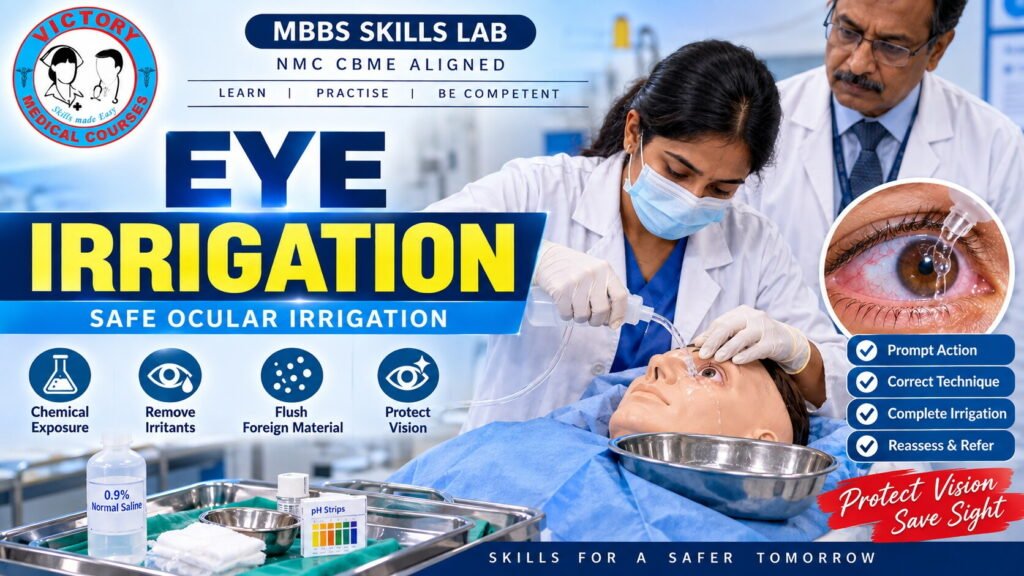
Eye Irrigation is an essential clinical skill for undergraduate medical students, particularly in the initial management of ocular contamination and chemical eye exposure.
This simulation-based course provides students with structured knowledge and hands-on practice to perform eye irrigation safely, systematically, and confidently. The course follows a DOAP approach — Demonstrate, Observe, Assist and Perform — allowing students to progress from understanding the procedure to independent performance.
Students learn to recognise appropriate indications, prepare the required equipment, position the patient correctly, perform controlled ocular irrigation, assess the ocular surface, examine the conjunctival fornices, and carry out appropriate reassessment following irrigation.
Particular emphasis is placed on prompt action in chemical eye injury, safe irrigation technique, prevention of contamination of the unaffected eye, and recognition of situations requiring urgent ophthalmology assessment.
LEARNING OBJECTIVES
By the end of this course, the learner should be able to:
KNOWLEDGE
- Define eye irrigation and explain its clinical purpose.
- Identify appropriate indications for ocular irrigation.
- Explain why prompt irrigation is important following chemical exposure.
- Identify appropriate irrigation fluids and equipment.
- Explain the role of ocular pH assessment when indicated.
- Describe the importance of irrigating the conjunctival sac and fornices.
- Identify clinical findings requiring urgent ophthalmology referral.
SKILLS
The learner will be able to:
- Prepare the equipment required for eye irrigation.
- Perform appropriate hand hygiene and use PPE.
- Explain the procedure to the patient.
- Position the patient safely.
- Protect the unaffected eye from contaminated fluid.
- Initiate irrigation appropriately.
- Use a gentle and controlled irrigation stream.
- Irrigate the accessible ocular surface systematically.
- Ask the patient to move the eye in different directions.
- Perform appropriate upper eyelid eversion.
- Examine and irrigate accessible conjunctival fornices.
- Reassess the patient following irrigation.
- Recognise situations requiring urgent specialist assessment.
- Document the procedure and findings appropriately.
PROFESSIONAL BEHAVIOUR
The learner will demonstrate:
- Effective communication
- Patient reassurance
- Respect for patient dignity
- Appropriate infection-control practice
- Safe handling of equipment
- Appropriate clinical judgement
- Recognition of personal limitations
- Timely escalation when required
COURSE CONTENT
MODULE 1 — INTRODUCTION TO EYE IRRIGATION
Students are introduced to:
- Definition of eye irrigation
- Purpose of irrigation
- Clinical importance
- Role of irrigation in ocular emergencies
- Learning objectives and competency expectations
MODULE 2 — INDICATIONS
Students learn to identify situations in which irrigation may be appropriate, including:
- Chemical eye exposure
- Irritant contamination
- Appropriate superficial ocular contamination
- Selected superficial foreign material
The course emphasises the importance of recognising a time-critical chemical eye injury and initiating appropriate irrigation promptly.
MODULE 3 — EQUIPMENT PREPARATION
Students identify and prepare:
- Irrigation fluid
- Irrigation tubing/delivery device
- Gloves
- Protective drape
- Kidney tray
- Sterile gauze
- pH strips when indicated
- Waste-disposal equipment
Students are encouraged to prepare the complete station before beginning the procedure.
MODULE 4 — PATIENT COMMUNICATION AND POSITIONING
Students practise:
- Introducing themselves
- Confirming patient identity
- Explaining the procedure
- Providing reassurance
- Maintaining privacy and dignity
- Positioning the patient correctly
- Protecting clothing and surrounding skin
- Preventing contaminated fluid from reaching the unaffected eye
MODULE 5 — OCULAR IRRIGATION TECHNIQUE
Students learn the complete procedural sequence:
Prepare → Position → Expose → Irrigate → Examine → Reassess
The practical component demonstrates:
- Appropriate irrigation-fluid delivery
- Gentle controlled flow
- Systematic irrigation
- Eye movement during irrigation
- Irrigation of accessible conjunctival areas
- Avoidance of excessive pressure
MODULE 6 — OCULAR pH ASSESSMENT
Students are introduced to the role of pH assessment in chemical ocular injury.
They learn:
- When pH assessment may be useful
- Appropriate technique
- The importance of reassessment when clinically indicated
- Why assessment should not unnecessarily delay initial irrigation
MODULE 7 — CONJUNCTIVAL SAC AND FORNIX IRRIGATION
Students learn why the entire accessible ocular surface must be considered.
The module covers:
- Lower conjunctival sac
- Medial and lateral areas
- Superior fornix
- Systematic eye movement
- Appropriate upper eyelid eversion
- Identification of retained material
MODULE 8 — SAFETY AND COMMON ERRORS
Important safety principles include:
- Do not unnecessarily delay irrigation in significant chemical exposure.
- Use a gentle, controlled irrigation stream.
- Avoid forceful direct pressure on the eye.
- Prevent contaminated fluid from reaching the unaffected eye.
- Do not manipulate an embedded or penetrating foreign body.
- Do not allow procedural steps to delay essential emergency management.
- Recognise when specialist assessment is required.
Common student errors are demonstrated and corrected through supervised practice.
MODULE 9 — POST-IRRIGATION REASSESSMENT
Students learn to reassess:
Vision
- Ask about visual changes.
- Assess visual acuity when clinically appropriate.
Ocular surface
- Look for persistent contamination or injury.
Symptoms
- Pain
- Burning
- Photophobia
- Watering
pH
- Reassess when clinically indicated.
The importance of reassessment rather than simply stopping when symptoms improve is emphasised.
MODULE 10 — REFERRAL AND ESCALATION
Students learn to recognise findings that require urgent ophthalmology assessment, including:
- Reduced vision
- Significant chemical injury
- Persistent abnormal ocular findings
- Significant corneal injury
- Severe or persistent symptoms
- Suspected penetrating injury
- Embedded foreign body
- Other significant ocular trauma
The course reinforces that initial irrigation does not replace specialist assessment when significant injury is suspected.