Course Introduction
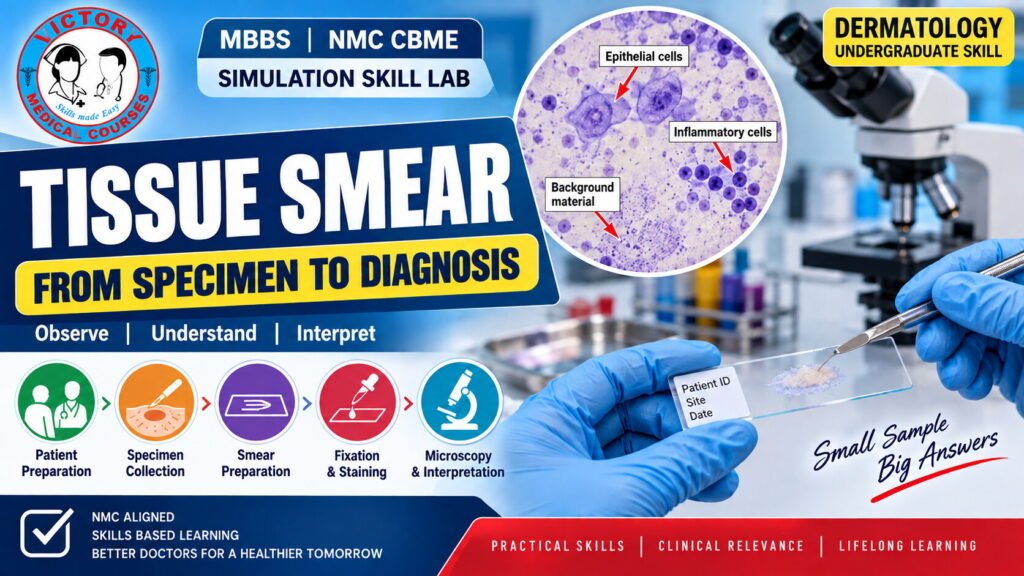
Tissue Smear is an NMC CBME-aligned undergraduate medical skills lesson designed to introduce MBBS students to the principles, clinical relevance, specimen handling, preparation, microscopy, and interpretation of tissue smears.
The course uses a simulation-based, demonstration and observation-oriented approach to help students understand the complete workflow from patient preparation and appropriate specimen selection to smear preparation, fixation, staining, microscopic examination and clinical correlation.
Tissue smear is listed as an “O – Observe on patient/simulation” skill in the NMC Skill Training framework. Therefore, the emphasis of this undergraduate session is on observation, understanding, recognition of correct technique, laboratory safety and basic interpretation, rather than independent invasive performance.
Learning Objectives
By the end of this course, the learner should be able to:
Knowledge
- Define a tissue smear.
- Explain the basic principle of tissue smear examination.
- Identify common clinical situations in which tissue smear may be useful.
- Explain the importance of selecting an appropriate representative specimen.
- Describe the general sequence of tissue smear preparation.
- Explain the purpose of fixation and staining.
- Describe the basic principles of microscopic examination.
- Explain the importance of clinical correlation.
- Identify common technical errors that can compromise specimen quality.
- Describe essential infection-prevention and laboratory-safety measures.
Skills
The learner will be able to observe and explain:
- Patient identification and preparation.
- Appropriate site selection.
- Principles of specimen collection.
- Preparation of a smear on a glass slide.
- Fixation and staining principles.
- Microscopic examination.
- Recognition of adequate and inadequate preparations.
- Basic interpretation of microscopic findings.
- Safe specimen and biomedical-waste handling.
Professionalism
The learner will understand the importance of:
- Patient dignity and privacy.
- Appropriate communication.
- Consent.
- Confidentiality.
- Infection prevention.
- Safe specimen handling.
- Correct specimen identification.
Course Content
Module 1 – Introduction to Tissue Smear
Students are introduced to the concept of tissue smear and its role in clinical diagnosis.
Topics include:
- Definition
- Principle
- Clinical relevance
- Role in dermatology and venereology
- NMC competency level
- Overview of the complete workflow
Module 2 – Indications and Specimen Selection
Students learn why the choice of specimen is critical.
Topics include:
- Appropriate clinical indications
- Selection of representative material
- Importance of lesion/site selection
- Specimen adequacy
- Avoiding superficial or non-representative material
- Avoiding contamination
Module 3 – Patient Preparation and Communication
This section emphasizes patient-centred clinical practice.
Students learn:
- Patient identification
- Explanation of the procedure
- Consent requirements
- Privacy and dignity
- Appropriate communication
- Hand hygiene
- PPE requirements
Module 4 – Equipment and Infection Control
Students become familiar with the equipment required for tissue smear preparation.
Topics include:
- Glass slides
- Slide labelling
- Specimen collection materials
- PPE
- Staining equipment
- Microscope
- Disinfectants
- Sharps containers
- Biomedical waste disposal
Module 5 – Specimen Collection
Through faculty demonstration and simulation, students observe the principles of specimen collection.
The session emphasizes:
- Correct site selection
- Adequate representative specimen
- Appropriate instrument handling
- Avoidance of contamination
- Safe specimen handling
- Prompt transfer and identification
Module 6 – Smear Preparation
Students learn the principles of preparing the specimen on a glass slide.
Topics include:
- Correct slide identification
- Transfer of specimen
- Appropriate spreading
- Smear thickness
- Distribution of material
- Avoidance of contamination
- Recognition of an adequate preparation
Module 7 – Fixation and Staining
Students are introduced to the principles of fixation and staining.
They learn:
- Why fixation is performed
- Importance of preserving specimen morphology
- Purpose of staining
- Selection of staining methods according to the clinical question
- Importance of following laboratory SOPs
- Consequences of inappropriate processing
Module 8 – Microscopic Examination
Students observe systematic examination of prepared slides.
Topics include:
- Microscope handling
- Initial assessment of specimen adequacy
- Appropriate magnification
- Systematic examination
- Cellular material
- Inflammatory cells
- Microorganisms when relevant
- Background material
- Recognition of technically inadequate preparations
Module 9 – Interpretation and Clinical Correlation
Students learn that microscopy should never be interpreted in isolation.
The course emphasizes:
Clinical presentation → Specimen adequacy → Microscopic findings → Clinical correlation → Further investigation when required
Students learn the importance of considering:
- History
- Physical examination
- Specimen quality
- Microscopic findings
- Differential diagnosis
- Additional laboratory investigations when indicated
Module 10 – Safety, Documentation and Key Takeaways
The final section reinforces:
- Infection prevention
- Sharps safety
- Biomedical waste management
- Laboratory safety
- Patient confidentiality
- Documentation
- Logbook entry
- NMC competency requirements