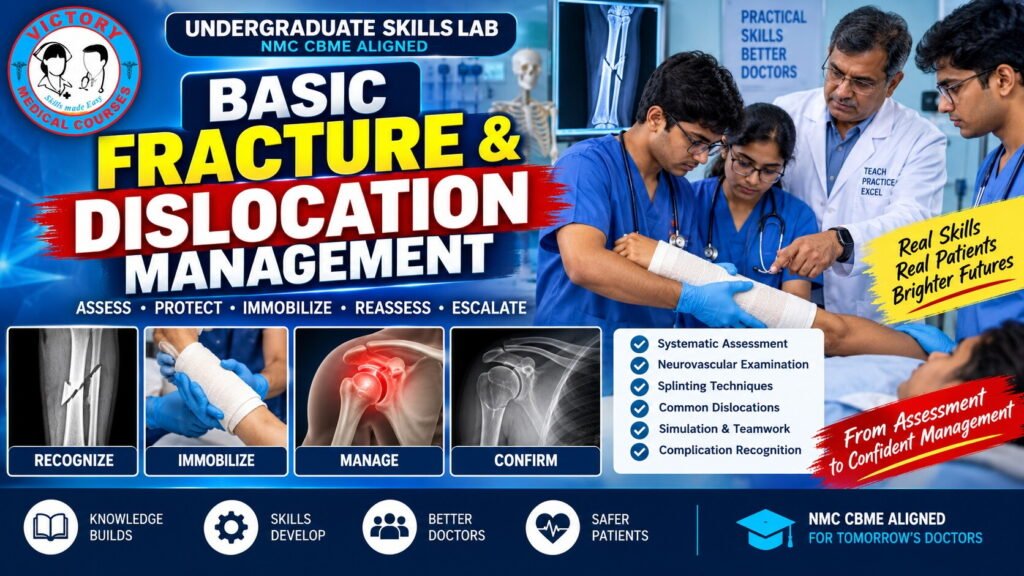
Basic Fracture & Dislocation Management is a competency-based clinical skills course designed for undergraduate medical students to develop a safe, systematic and practical approach to patients presenting with fractures and common joint dislocations. The course integrates essential orthopaedic knowledge with simulation-based clinical skills, enabling students to progress from recognition and assessment to appropriate initial management, immobilization, reassessment and escalation.
The course follows the principles of the NMC Competency-Based Medical Education (CBME) curriculum, with particular emphasis on trauma assessment, common dislocations, neurovascular evaluation and supervised participation in closed reduction.
COURSE CONTENT
Module 1 — Introduction to Fractures & Dislocations
Students are introduced to the definitions of fracture, dislocation and subluxation, common mechanisms of injury, and the clinical importance of early recognition and safe management.
Module 2 — Initial Trauma Assessment
Students learn the ABCDE approach to trauma and understand why life-threatening conditions must be addressed before focusing on an isolated limb injury.
Module 3 — Clinical Assessment of Fractures
The course demonstrates how to recognize pain, swelling, tenderness, deformity, loss of function and other features suggestive of fracture while emphasizing gentle examination and avoidance of unnecessary manipulation.
Module 4 — Neurovascular Assessment
A core practical component of the course. Students practice assessment of:
- Distal pulses
- Capillary refill
- Skin colour and temperature
- Motor function
- Sensory function
Particular emphasis is placed on documenting neurovascular status before and after immobilization or reduction.
Module 5 — Basic Fracture Imaging
Students are introduced to systematic assessment of fracture radiographs, including alignment, bone integrity, joint involvement, displacement and associated injuries, with emphasis on appropriate orthogonal views.
Module 6 — Initial Fracture Management
Students learn the basic principles of:
Analgesia → Neurovascular assessment → Immobilization → Reassessment → Definitive referral/management
The role of splints, casts and other methods of stabilization is discussed, while distinguishing emergency immobilization from definitive fracture treatment.
Module 7 — Open Fractures & Emergency Red Flags
Students learn to recognize open fractures and understand the importance of appropriate wound covering, bleeding control, immobilization, antibiotic/tetanus management according to local protocol, and urgent orthopaedic/surgical assessment.
The course also highlights:
- Compartment syndrome
- Vascular compromise
- Nerve injury
- Severe bleeding
- Unstable polytrauma
- Fracture-dislocation
- Limb-threatening injuries
Module 8 — Common Joint Dislocations
Students learn to recognize common dislocations involving the:
- Shoulder
- Hip
- Knee
- Finger joints
The focus is on recognition, neurovascular assessment, appropriate investigation, analgesia, supervised reduction, immobilization and reassessment.
Module 9 — Closed Reduction Team Simulation
Through simulation, students learn the team-based approach to closed reduction. They understand their role as undergraduate learners and participate under appropriate supervision rather than attempting independent forceful reduction.
Team roles include:
- Operator/assistant
- Neurovascular assessor
- Monitoring assistant
- Documentation/communication member
Module 10 — Post-Reduction Care & Competency Assessment
Students practice post-reduction neurovascular assessment, appropriate immobilization, confirmation of alignment where indicated, documentation, complication recognition and referral/follow-up planning.
The course concludes with DOPS/OSCE-style competency assessment.