
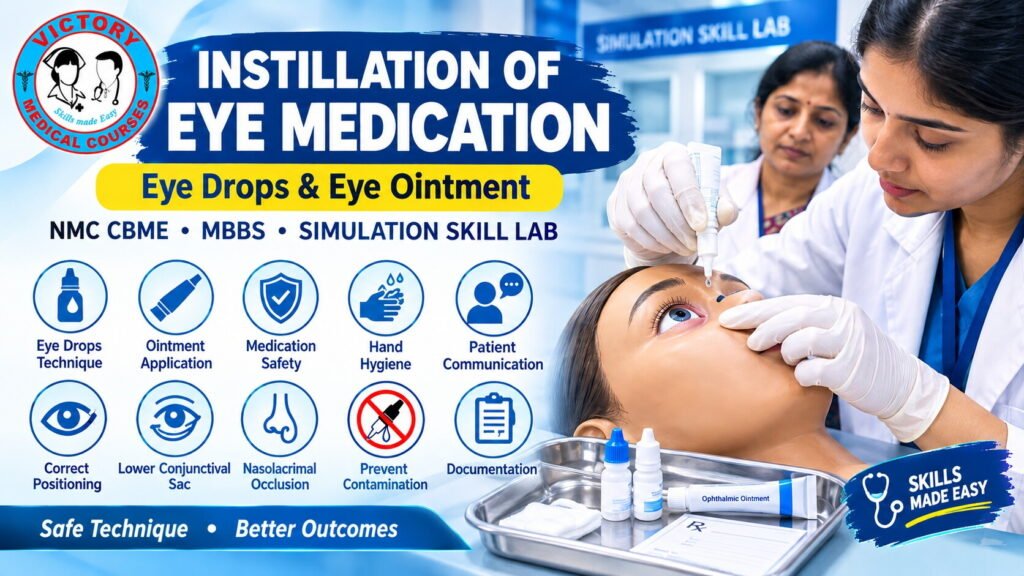
Instillation of Eye Medication – Eye Drops & Eye Ointment
The Instillation of Eye Medication – Eye Drops & Eye Ointment course is a practical, competency-oriented learning module designed for undergraduate MBBS students. It focuses on developing the knowledge, technical skills, medication-safety practices and professional behaviour required for safe administration of ophthalmic medications.
The course is specifically structured around the NMC undergraduate curriculum competency requiring students to demonstrate the correct technique of instillation of eye drops in a simulated environment. The NMC curriculum identifies a DOAP (Demonstrate, Observe, Assess, Perform) approach and skill assessment for this competency.
Learning Outcomes
By the end of the course, the learner should be able to:
- Explain the indications and basic principles of ophthalmic medication administration.
- Verify the correct patient, medication, dose, eye and relevant precautions before administration.
- Perform appropriate hand hygiene and prepare the required equipment.
- Communicate with the patient and explain the procedure appropriately.
- Position the patient correctly and maintain comfort and dignity.
- Expose the lower conjunctival sac safely.
- Instill eye drops without touching the dropper tip to the eye, eyelashes or surrounding tissues.
- Apply ophthalmic ointment correctly into the lower conjunctival sac.
- Demonstrate appropriate post-administration care, including gentle eye closure and nasolacrimal occlusion when appropriate.
- Recognize and prevent common errors and contamination.
- Provide appropriate patient instructions following administration.
- Document the procedure appropriately.
- Demonstrate the complete procedure independently in a simulation environment.
Course Content
The course covers:
Module 1 – Introduction
- Purpose of ophthalmic medication administration
- Common forms of ophthalmic medication
- Eye drops versus eye ointment
- Basic principles of safe administration
Module 2 – Medication Safety
- Patient identification
- Medication verification
- Correct eye verification
- Dose and frequency
- Expiry date and container integrity
- Relevant allergies and precautions
Module 3 – Preparation and Infection Prevention
- Hand hygiene
- Equipment preparation
- Maintaining aseptic technique
- Prevention of contamination
- Safe handling of ophthalmic containers
Module 4 – Patient Communication and Positioning
- Introducing and explaining the procedure
- Obtaining cooperation
- Maintaining privacy and dignity
- Correct patient positioning
- Preparing the patient for the sensation associated with administration
Module 5 – Eye Drop Instillation
- Correct handling of the dropper
- Exposure of the lower conjunctival sac
- Appropriate eye position
- Correct placement of the prescribed drop
- Avoiding contact with the cornea and surrounding structures
- Gentle eye closure following administration
Module 6 – Nasolacrimal Occlusion and Aftercare
- Purpose of gentle medial canthal/nasolacrimal occlusion when appropriate
- Prevention of unnecessary drainage
- Cleaning excess medication
- Patient instructions and precautions
Module 7 – Multiple Ophthalmic Medications
- Administration of multiple preparations
- Appropriate separation between medications
- Avoiding cross-contamination
- Following medication-specific instructions and institutional protocols
Module 8 – Ophthalmic Ointment
- Preparation and positioning
- Lower conjunctival sac technique
- Application of a small ribbon of ointment
- Prevention of tube-tip contamination
- Post-application advice, including temporary blurred vision
Module 9 – Common Errors and Safety
Students learn to identify and correct common errors such as:
- Using the wrong medication or wrong eye
- Touching the dropper tip to the eye or eyelashes
- Instilling medication directly onto the cornea
- Excessive squeezing of the eyelids
- Poor hand hygiene
- Contamination of the medication
- Failure to provide appropriate aftercare
Module 10 – Competency Assessment
- Post-course MCQ assessment
- Simulation practice
- Direct observation
- DOPS assessment
- Individual feedback
- Remediation and repeat practice when required