Course Title
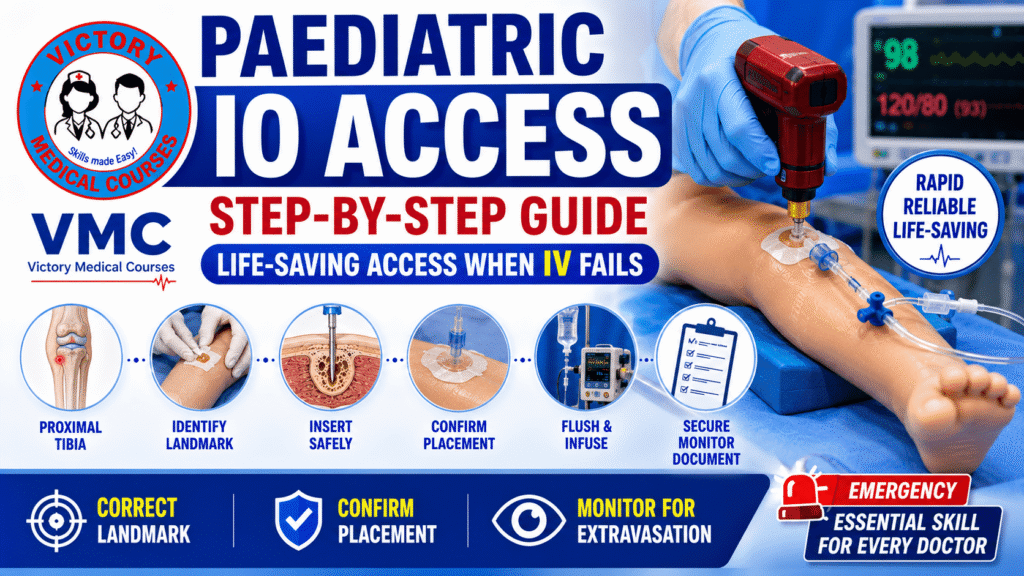
Paediatric Intraosseous (IO) Access – Emergency Vascular Access in Infants and Children
Target Learners
MBBS students and undergraduate medical trainees undergoing competency-based emergency and procedural skills training.
Course Overview
This practical, simulation-based course introduces students to intraosseous vascular access in infants and children when rapid vascular access is required and peripheral IV access cannot be obtained promptly.
The course follows a step-by-step, competency-based approach, beginning with recognition of the clinical indications and progressing through equipment preparation, anatomical landmark identification, site selection, safe insertion, confirmation of placement, flushing and infusion, secure fixation, monitoring, recognition of complications, and documentation.
Students learn primarily through demonstration and hands-on practice using paediatric IO training manikins, allowing them to develop procedural confidence in a safe environment before supervised clinical application.
What Students Will Learn
By completing the course, students will be able to:
- Recognize situations requiring emergency IO access.
- Identify appropriate paediatric IO insertion sites.
- Identify important contraindications and unsafe sites.
- Prepare the required IO equipment.
- Select an appropriate IO needle/device based on the child, site and manufacturer guidance.
- Identify the correct anatomical landmark.
- Demonstrate appropriate positioning and aseptic preparation.
- Perform IO insertion safely on a training manikin.
- Confirm correct IO placement.
- Demonstrate flushing and administration of fluids or medications.
- Secure and monitor the IO line.
- Recognize complications such as extravasation, compartment syndrome, fracture, growth-plate injury, infection and accidental dislodgement.
- Document the procedure appropriately.
- Understand the importance of transitioning to definitive vascular access when appropriate.
Course Structure
Module 1 – Introduction
Understanding IO access and its role in paediatric emergencies.
Module 2 – Indications
When IO access should be considered in critically ill children.
Module 3 – Anatomy & Site Selection
Proximal tibia, distal tibia, distal femur and proximal humerus, with emphasis on anatomical landmarks and avoidance of growth plates.
Module 4 – Equipment
IO devices, needles, extension tubing, flush, stabilization equipment and infusion equipment.
Module 5 – Preparation
Child positioning, limb stabilization, aseptic preparation and team communication.
Module 6 – IO Insertion
Step-by-step demonstration of safe device positioning and insertion.
Module 7 – Confirmation & Infusion
Confirmation of placement, flushing, infusion and use of pressure when required.
Module 8 – Complications
Recognition, prevention and immediate response to common complications.
Module 9 – Securing, Monitoring & Documentation
Maintaining access safely, monitoring the child and documenting the procedure.
Module 10 – Best-Practice Summary
A complete 12-step workflow reinforcing safe and systematic IO access.
Learning Resources
The course includes:
- 15 illustrated teaching images
- Step-by-step procedural demonstrations
- Anatomical illustrations
- Clinical scenarios
- Paediatric IO equipment guide
- Complications infographic
- Pre-test and post-test MCQ’s to assess your knowledge.