
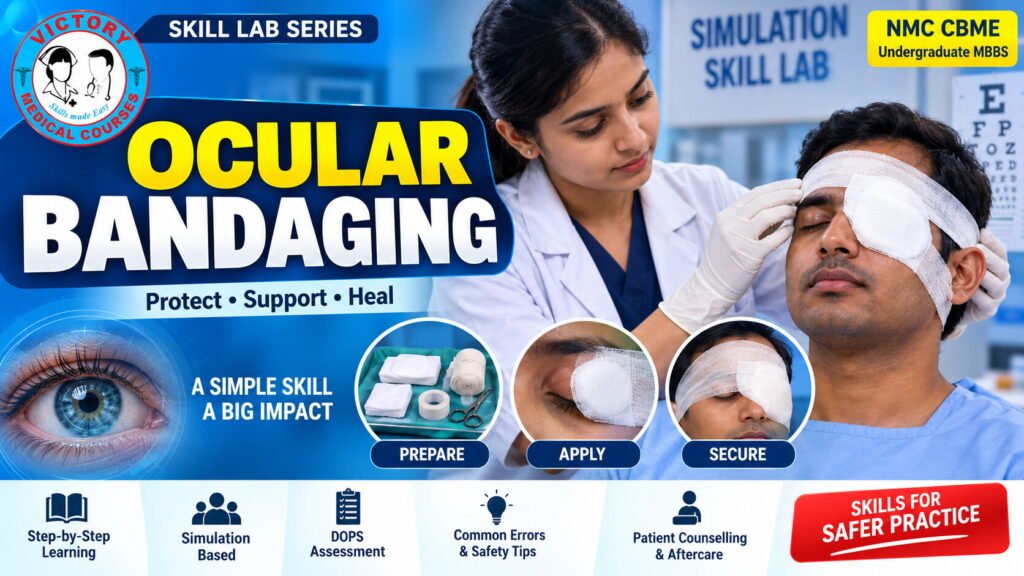
OCULAR BANDAGING
Ocular Bandaging is a structured, simulation-based clinical skills course designed for undergraduate MBBS students to develop the knowledge, technical skills, clinical judgment, communication skills, and professional behaviour required for safe and appropriate ocular bandaging.
The course takes the learner beyond simply learning how to apply an eye pad and bandage. Students are trained to assess the clinical situation first, confirm that bandaging is appropriate, identify important warning signs, communicate with the patient, obtain consent, perform the procedure correctly, reassess the dressing, and provide appropriate aftercare advice.
Through a combination of concise theoretical instruction, faculty demonstration, step-by-step guided practice, independent simulation practice, and DOPS-based assessment, learners progress from understanding the procedure to demonstrating competency.
LEARNING OUTCOMES
At the completion of the course, the learner should be able to:
Knowledge
- Define ocular bandaging.
- Explain the purpose of an ocular bandage.
- Identify appropriate clinical indications.
- Recognize important precautions and situations where routine bandaging may be inappropriate.
- Identify the equipment required.
- Describe the correct sequence of ocular bandaging.
- Recognize common procedural errors.
- Describe appropriate aftercare and warning signs.
Practical Skills
The learner should be able to:
- Identify the patient correctly.
- Confirm the affected eye.
- Assess whether the procedure is appropriate.
- Recognize important red flags.
- Explain the procedure to the patient.
- Obtain informed consent.
- Perform appropriate hand hygiene.
- Prepare the required equipment.
- Position the patient appropriately.
- Place the eye pad correctly over the gently closed affected eye.
- Apply the bandage using appropriate technique.
- Maintain controlled tension.
- Avoid excessive pressure on the eye.
- Check the final dressing.
- Assess patient comfort.
- Provide appropriate aftercare instructions.
- Complete the procedure safely.
Communication and Professionalism
The learner should demonstrate:
- Respectful patient communication
- Appropriate introduction and explanation
- Consent before the procedure
- Reassurance
- Protection of patient privacy and dignity
- Appropriate handling of the eye
- Attention to patient comfort
- Clear safety-netting advice
COURSE CONTENT
MODULE 1 – Introduction to Ocular Bandaging
Students are introduced to:
- Definition
- Purpose
- Clinical relevance
- Role of ocular protection
- Principles of safe bandaging
- Importance of clinical judgment
Key message
Ocular bandaging is not simply a mechanical procedure. The underlying clinical condition must be considered before applying a dressing.
MODULE 2 – Indications, Precautions & Safety Assessment
Students learn to distinguish situations in which ocular bandaging may be appropriate from situations requiring further assessment or urgent ophthalmic management.
Important warning situations include:
- Suspected penetrating or open-globe injury
- Significant ocular trauma
- Retained foreign body
- Chemical eye injury before appropriate irrigation and assessment
- Severe unexplained eye pain
- Significant or sudden reduction in vision
- Suspected corneal ulcer or serious infection
- Significant bleeding or concerning discharge
The module reinforces:
Clinical assessment comes before procedural performance.
MODULE 3 – Equipment Preparation
Students learn to identify and prepare the equipment required for the procedure.
Typical equipment includes:
- Eye pad
- Appropriate gauze/dressing material
- Roller bandage
- Adhesive tape when required
- Scissors
- Hand hygiene supplies
- Gloves when clinically indicated
- Waste disposal facility
- Simulation model or standardized patient
The importance of organized preparation before beginning the procedure is emphasized.
MODULE 4 – Patient Identification, Explanation & Consent
Students practice:
- Introducing themselves
- Confirming patient identity
- Confirming the correct eye
- Explaining the procedure
- Explaining what the patient may experience
- Obtaining consent
- Providing reassurance
Students are encouraged to use clear, simple, patient-friendly language.
MODULE 5 – Hand Hygiene & Aseptic Preparation
This module reinforces infection-prevention principles.
Students learn:
- When hand hygiene should be performed
- Appropriate use of gloves
- Avoidance of unnecessary contamination
- Safe handling of eye pads and equipment
- Appropriate disposal after completion
MODULE 6 – Patient Positioning & Eye Pad Placement
Students learn to:
- Position the patient comfortably
- Provide adequate support
- Ask the patient to gently close the affected eye
- Position the eye pad appropriately
- Avoid unnecessary pressure or manipulation
The correct position of the eye pad is demonstrated from different viewing angles.
MODULE 7 – Correct Ocular Bandaging Technique
This is the core practical component of the course.
Students learn the systematic technique of:
- Confirming the correct eye
- Positioning the patient
- Asking the patient to gently close the eye
- Positioning the eye pad
- Applying the bandage
- Maintaining appropriate tension
- Securing the dressing
- Checking the final position
Core principle
SECURE WITHOUT EXCESSIVE PRESSURE
MODULE 8 – Common Errors & Safety Considerations
Students learn to identify and prevent common errors, including:
- Failure to confirm the correct eye
- Failure to confirm the indication
- Ignoring clinical red flags
- Poor hand hygiene
- Incorrect eye-pad placement
- Excessive bandage tension
- Inadequately secured dressing
- Failure to assess comfort
- Failure to provide aftercare instructions
The module emphasizes that recognizing and correcting errors is an important part of competency development.
MODULE 9 – Final Dressing Check
Before completing the procedure, students learn to systematically assess:
- Correct eye
- Eye-pad position
- Bandage position
- Security
- Pressure
- Patient comfort
- Overall appearance of the dressing
The patient should be asked about comfort before the student leaves.
MODULE 10 – Patient Counselling & Aftercare
Students learn to provide clear post-procedure instructions.
Patients should be advised, as appropriate, to:
- Keep the dressing clean and dry
- Avoid rubbing or pressing the eye
- Follow prescribed medication instructions
- Follow the planned review schedule
- Avoid manipulating or tightening the dressing themselves
Warning signs requiring prompt medical review
Students should recognize and communicate symptoms such as:
- Increasing eye pain
- Worsening vision
- Increasing swelling
- Bleeding
- Significant discharge
- Increasing discomfort
- Other new concerning symptoms
MODULE 11 – Complete Procedure Demonstration
Students observe the complete procedure from beginning to end.
The demonstration integrates:
Patient identification → Assessment → Explanation → Consent → Hand hygiene → Equipment → Positioning → Eye pad → Bandage → Final check → Counselling → Completion
This allows learners to understand how individual steps fit into a complete clinical workflow.
MODULE 12 – Competency Assessment
Students independently perform ocular bandaging in the simulation environment.
Assessment is performed using a structured Direct Observation of Procedural Skills (DOPS) format.
The assessment considers:
- Clinical judgment
- Patient identification
- Correct-eye identification
- Safety assessment
- Consent
- Infection prevention
- Equipment preparation
- Technical performance
- Pressure control
- Dressing security
- Patient comfort
- Counselling
- Professional communication
- Overall safe completion