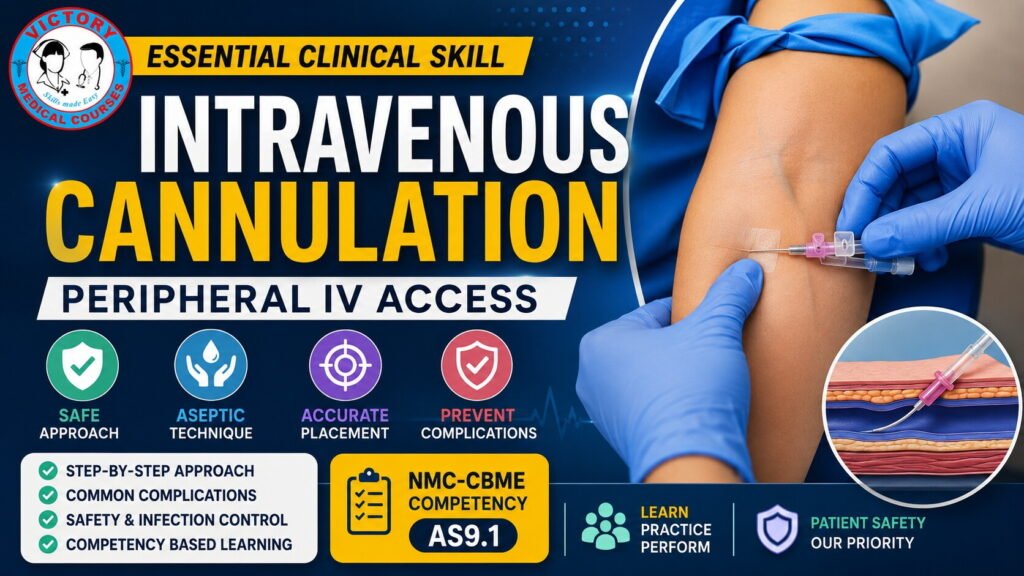
Peripheral Intravenous Cannulation
is a structured, competency-based simulation skills course designed to equip undergraduate medical students with the knowledge, technical skills, clinical reasoning, and professional behaviours required to safely establish peripheral intravenous access.
The course follows a simulation-first, hands-on learning approach, allowing students to learn the procedure through faculty demonstration, guided practice, DOAP methodology, deliberate practice, and structured competency assessment before progressing to supervised clinical practice.
What Students Will Learn
Students will learn to:
- Understand the indications and clinical purposes of peripheral IV access.
- Identify appropriate veins and select suitable cannulation sites.
- Select the appropriate IV cannula size based on clinical requirements and vein characteristics.
- Prepare the required equipment systematically.
- Perform appropriate hand hygiene and maintain aseptic/non-touch technique.
- Prepare the cannulation site using appropriate skin antisepsis.
- Demonstrate correct peripheral IV cannulation technique on a simulation model.
- Recognize venous entry and safely advance the catheter.
- Connect, assess, secure, and appropriately care for the cannula.
- Dispose of needles and other sharps safely.
- Recognize common complications such as infiltration, hematoma, phlebitis and other local complications.
- Respond appropriately to an unsuccessful cannulation attempt.
- Recognize personal limitations and seek appropriate assistance.
- Communicate effectively and professionally with patients.
- Document the procedure appropriately according to institutional practice.
Teaching and Learning Methodology
The course uses Small Group Teaching, Demonstration, DOAP (Demonstrate–Observe–Assess–Perform), deliberate practice and simulation-based learning.
Students first observe a complete faculty demonstration before the procedure is broken down into individual steps. They then practise repeatedly on realistic IV training models under faculty supervision. Specific technical errors are identified and corrected through targeted coaching.
Simulation provides students with a safe environment to develop procedural confidence, allowing them to practise without exposing real patients to unnecessary discomfort or risk.
Assessment Strategy
Learning is assessed using a combination of:
Pre-course assessment:
A 10-question MCQ assessment establishes the student’s baseline knowledge.
Post-course assessment:
A structured 10-question MCQ assessment evaluates knowledge acquisition following the teaching session.
DOPS:
Direct Observation of Procedural Skills assesses the student’s ability to perform peripheral IV cannulation safely and systematically.
The DOPS assessment focuses on preparation, communication, infection prevention, equipment and site selection, cannulation technique, sharps safety, catheter management, complication recognition, and professionalism.
Patient Safety Focus
Patient safety is central to the course. Particular emphasis is placed on:
Aseptic technique • Safe sharps disposal • Appropriate site selection • Recognition of complications • Prevention of needlestick injury • Knowing when to stop and seek help
Students are taught that successful cannulation alone does not constitute competency. Competency requires safe, reproducible, professional and patient-centred performance.
Expected Outcome
By the end of the course, students should be able to demonstrate a structured approach to peripheral IV cannulation in a simulated environment and explain the rationale behind each major step. They should be able to identify and respond appropriately to common complications and demonstrate safe escalation when they are unable to establish IV access.
The course ultimately aims to bridge the gap between theoretical knowledge and supervised clinical practice, giving students the confidence and foundational competence required for one of the most frequently performed procedures in clinical medicine.
Course Structure
1. Pre-Lesson Knowledge Assessment
↓
2. Interactive Introduction & Clinical Principles
↓
3. Equipment & Cannula Selection
↓
4. Vein Selection & Aseptic Preparation
↓
5. Faculty Demonstration
↓
6. DOAP-Based Hands-On Practice
↓
7. Deliberate Practice & Error Correction
↓
8. Complication Recognition & Safety Scenarios
↓
9. DOPS Competency Assessment
↓
10. Post-Course Knowledge Assessment & Feedback
Intended Learners
Undergraduate MBBS students undertaking competency-based clinical and procedural skills training.
Course Philosophy
“Learn safely. Practise repeatedly. Perform confidently.”
This course transforms peripheral IV cannulation from a theoretical procedure into a structured, practice-based and competency-oriented clinical skill suitable for progression into supervised patient care.