1. About the Course
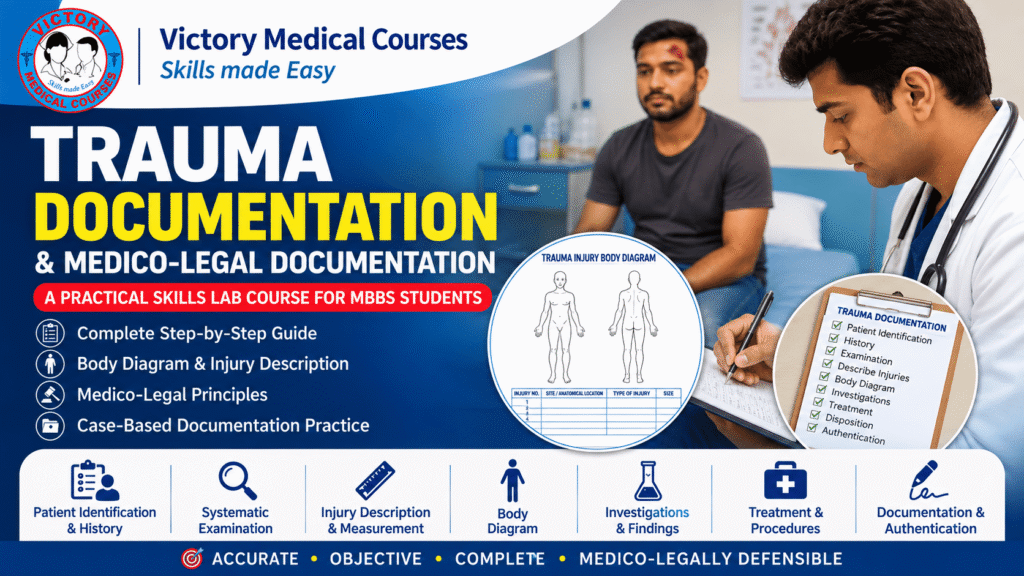
Trauma Documentation & Medico-Legal Documentation is a practical, competency-oriented course designed to help undergraduate MBBS students develop the knowledge, skills, and professional attitudes required for accurate documentation of trauma cases.
Trauma documentation is an important part of clinical practice as well as medico-legal practice. A well-prepared medical record should accurately communicate what the patient reported, what the doctor observed, what investigations were performed, what treatment was provided, and what happened subsequently.
This course moves beyond theoretical learning and provides students with a structured approach to documenting simulated trauma cases. Students learn to distinguish between alleged history, objective examination findings, and medical opinion, while developing the ability to describe injuries precisely and systematically.
2. Why This Course Is Important
In clinical practice, trauma cases frequently require careful documentation. Poor documentation can result from vague injury descriptions, missing measurements, inadequate anatomical localization, failure to record relevant findings, or inappropriate conclusions.
This course therefore emphasizes:
- Accuracy
- Objectivity
- Completeness
- Chronological documentation
- Anatomical precision
- Appropriate medico-legal awareness
- Professional communication
- Patient confidentiality
- Proper authentication of medical records
Students are encouraged to develop documentation habits that can be applied during emergency department encounters, clinical postings, medico-legal cases, and future independent medical practice.
3. Course Learning Objectives
By the end of this course, the learner should be able to:
Knowledge
- Explain the clinical and medico-legal importance of trauma documentation.
- Identify the essential components of a trauma case record.
- Explain the difference between alleged history, examination findings, and medical opinion.
- Describe the essential elements of injury documentation.
- Explain the role of body diagrams in documenting injuries.
- Identify common errors in trauma and medico-legal documentation.
Skills
The learner should be able to:
- Correctly identify the patient.
- Record date, time, and relevant examination details.
- Document the alleged history objectively.
- Perform and document a systematic trauma examination.
- Identify and document relevant positive and negative findings.
- Describe injuries systematically.
- Record precise anatomical location and laterality.
- Measure and document injuries appropriately.
- Correlate written injury descriptions with a body diagram.
- Document investigations and significant findings.
- Document treatment, procedures, referral, and disposition.
- Complete and authenticate the documentation appropriately.
Professionalism
The learner should demonstrate:
- Objectivity
- Accuracy
- Professional language
- Respect for patient dignity
- Confidentiality
- Awareness of medico-legal responsibilities
- Avoidance of unsupported conclusions
4. Course Content
The course follows a structured trauma-documentation workflow:
Module 1 – Importance of Trauma Documentation
Students learn why accurate documentation is important for:
- Continuity of care
- Communication between healthcare professionals
- Clinical decision-making
- Medical records
- Medico-legal requirements
Module 2 – Patient Identification and Timing
Students learn to document:
- Patient identification
- Registration/hospital number
- Age and sex
- Date of examination
- Time of examination
- Relevant identification details
The importance of accurate chronology is emphasized.
Module 3 – Documenting the Alleged History
Students learn how to document the patient’s account objectively.
Particular emphasis is placed on distinguishing:
What the patient states
from
What the doctor personally observes.
Students are taught to avoid converting allegations into established facts.
Module 4 – Systematic Trauma Examination
Students learn to document relevant findings from a systematic examination.
The course emphasizes:
EXAMINE → OBSERVE → DOCUMENT
Students learn to record findings without introducing assumptions or unsupported conclusions.
Module 5 – Injury Description
Students learn a systematic approach to injury description:
NUMBER → TYPE → SITE → SIZE → CHARACTERISTICS → ASSOCIATED FINDINGS
Depending on the injury, documentation may include:
- Type of injury
- Number
- Anatomical site
- Side
- Measurements
- Shape
- Margins
- Orientation
- Associated findings
Module 6 – Body Diagram and Anatomical Localization
Students learn how to:
- Identify the precise anatomical location of injuries.
- Record right and left sides correctly.
- Number injuries.
- Mark injuries on a body diagram.
- Correlate diagrammatic findings with written descriptions.
The course emphasizes that the body diagram supplements the written description and does not replace it.
Module 7 – Positive and Relevant Negative Findings
Students learn to document important findings that are present as well as clinically relevant findings that were specifically assessed and absent.
Examples include:
- No active bleeding
- No obvious deformity
- Distal neurovascular status intact
- No focal neurological deficit
Students are encouraged to document relevant findings rather than produce unnecessary lists of normal observations.
Module 8 – Investigations, Treatment and Disposition
Students learn to document the subsequent management pathway:
INVESTIGATION → RESULT → TREATMENT → REFERRAL → DISPOSITION
This helps create a chronological record that allows another healthcare professional to understand the patient’s clinical course.
Module 9 – Common Documentation Errors
Students identify and correct common errors such as:
- Vague injury descriptions
- Inadequate anatomical localization
- Missing measurements
- Failure to document date/time
- Recording allegations as facts
- Unsupported opinions
- Missing relevant examination findings
- Incomplete treatment documentation
- Improper alteration of records
- Inadequate authentication
Module 10 – Complete Trauma Documentation
The final module integrates the entire skill into a complete documentation workflow:
IDENTIFY → HISTORY → EXAMINE → DESCRIBE → DIAGRAM → INVESTIGATE → TREAT → OPINE APPROPRIATELY → AUTHENTICATE
Students apply this framework to simulated trauma cases.
5. Simulation-Based Learning
The course uses six simulated trauma cases to provide progressive practice.
Case 1 – Road Traffic Collision
Focus:
Complete trauma documentation and injury description
Case 2 – Alleged Assault
Focus:
Separating patient allegation from objective findings
Case 3 – Fall from Stairs
Focus:
Precise injury description and body-diagram documentation
Case 4 – Workplace Injury
Focus:
Chronological and complete documentation
Case 5 – Head Injury
Focus:
Positive and relevant negative findings
Case 6 – Documentation Error Challenge
Focus:
Recognition and correction of medico-legal documentation errors